显示标签为“
anti-submarine warfare and anti-shipping aircraft”的博文。
显示所有博文
显示标签为“
anti-submarine warfare and anti-shipping aircraft”的博文。
显示所有博文
The US Navy has operated the land-based P-3 Orion maritime patrol aircraft for anti-submarine warfare and anti-shipping, as well as for overland surveillance, reconnaissance, mine-laying, drug interdiction logistic, threat simulation crew training and search and rescue missions.
Although developed to counter the Soviet submarine threat, the maritime patrol force, greatly reduced in size since the end of the Cold War, finds itself in great demand in the littoral warfare environment of the early 21st century. The current front-line version is the P-3C which equips 12 active and seven reserve patrol squadrons the P-3C entered service in Baseline form in 1969 and has been upgraded since through various update configurations. Modifications to their equipment has sharpened their capabilities. The Lockheed P-3 Orion is currently in service with 15 countries.

The P-3C has a sophisticated sensor suite including the UYYS-1 acoustic sonobuoy processor and ALR-66 electronic surveilance system, plus magnethic anomaly detection gear, and infre-red detection system and a search radar. Some aircraft are equipped with the APS-137 imaging synthetic aperture radar which can display an image of its target.
P-3Cs are currently undergoing several upgrade programmes to extend airframe life until 2015 and to improve their mission suites and armament. The US Navy is gradually upgrading most P-3Cs to an Update III Common Configuration that will be the Fleet standard. The Anti-Surface Improvement Program (AIP) is planned for 146 P-3Cs and includes enhancements in command, control, communications and intelligence, over the horizon targeting and survivability. New weapons such as Maverick, SLAM and SLAM-ER give the P-3 as potent stand-off land attack capability.
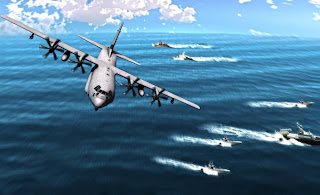
The first AIP P-3C entered service in 1998. Twelve Ep-3Es serve in the long-range reconnaissance role, equipped with the Aries II mission avionics suite. US Navy Special Projects Units fly small numbers of modified P-3Bs and P-3Cs for tactical and strategic intelligence collection. P-3A/Bs serve in the maritime patrol role with Argentina, Greece, Norway, Portugal, Spain and Thailand while P-3Cs serve with Australia, Iran, the Netherlands, Norway, Japan, Pakistan and South Korea. Japan operates 110 Kawasaki-built P-3Js while Canada has 18 CP-140 Auroras fitted with different mission avionics to US Navy P-3Cs.
The US Navy's Orion fleet is due to be replaced with the new Boeing P-8 Poseidon. First aircraft are expected to enter service in 2013.
The Boeing P-8 Poseidon is the US Navy's next generation long-range maritime patrol, anti-submarine warfare, anti-shipping, intelligence, surveillance and reconnaissance aircraft. In 2011 the US Navy awarded a contract for six initial production P-8A Poseidon aircraft. The first operational aircraft was delivered in 2012. The US Navy plans to purchase a total of 117 Poseidon maritime patrol aircraft to replace the previous Lockheed P-3 Orion fleet, that are approaching the end of their operational life. Australia and India also ordered this new aircraft.

The P-8A is a derivative of the ubiquitous commercial Boeing 737-800 and has a wings of the 737-900. It is larger than the previous Lockheed P-3. The Poseidon has additional fuel tanks in the aft for extended range. It is worth mentioning that it's maximum fuel capacity is 34 t and gives it a flight endurance of 4 hours on station.
The new aircraft is powered by two high-bypass CFM International CFM56-7B turbofan engines. The turbofan engines were deliberately selected, as they are more powerful, more fuel efficient and have a number of other advantages. The same engines are used on Australian and Turkish Boeing 737 airborne early warning and control aircraft, as well as the US Navy's C-40 Clipper transport. The Poseidon is not the only maritime patrol aircraft to use the jet engines. The British Nimrod has filled a similar role for decades. Despite that the Poseidon can loiter at a speed of 333 km/h over the sea at an altitude of only 60 m.

This maritime patrol and ASW aircraft will have up to 7 operator consoles in it's cabin. Aircraft will have electro-optical and infrared sensor turret, maritime surveillance radar, signal intelligence system. It's radar is capable of detection, classification and identification of ships, small vessels and surfaced submarines. It also has costal surveillance capability. The P-8A will be also fitted with advanced magnetic anomaly detection system for submarine tracking. The Poseidon can be used for search and rescue operations.

The Boeing P-8A Poseidon will carry lightweight Raytheon Mk.54 anti-submarine torpedoes. It may also carry other torpedoes, missiles, free-fall bombs, depth charges, mines, or sonbuoys in it's rotary integral weapon bay, located beneath the forward section of the fuselage. Air-to-surface and air-to air missiles, such as Harpoon anti-ship missiles, SLAM or AGM-65 Maverick land attack missiles, and AIM-9 Sidewinders or AIM-120 AMRAAMs will be carried on the underwing hardpoints.
Ilyushin's Il-18 was a major milestone in the development of Soviet commercial aviation. Its performance, capacity and reliability made it an obvious choice for adaptation of reduntant airframes for military roles. The first cush conversion was the Il-20M (NATO Coot-A) dedicated strategic Elint/radar reconnaissance aircraft. Fitted with a side-looking airborne radar, cameras and other optical sensors, the Coot-A can be regarded as the Soviet answer to the Boeing RC-135 series.
The Il-22 Coot-B airborne command post variant was developed by the Myasischev design bureau and is available in two versions: the Il-18Ds and new-build aircraft.
Four Il-20RTs built as dedicated tracking aircraft for space flight support remain in Russian air force and naval aviation as trainers and transports.
Il-18Ds and reconverted Il-22s also serve as staff/VIP transports.
The Il-38 (NATO May) long-range maritime patrol and ASW aircraft entered service in 1968. Production comprised up to 65 aircraft. Search sensors include a Berkut STS (NATO Wet Eye) search radar and associated sonobuoys and a tail-mounted APM-73 magnetic anomaly detector. The May also carried out maritime search and rescue and reconnaissance roles for which some aircraft were retrofitted with the Vishnya Comint system.

Most of the former Soviet Il-38s remain in use with the naval aviation. The sole export operator is the Indian Navy which received five Il-38s to equip INAS 315 Sqn at Dabolim. In 1999 the Indian Mays received an upgraded mission avionics/ESM suite - possibly the Morskoy Zmey search and targeting system developed by the Leninets Holding Company. With continuing production of the Tu-142 Bear-F, Russian Il-38s may adopt a shorter-range role, and due to their excellent reliability and safety record, are scheduled to remain in viable service up to at least 2012.


